Scientific evidence of the complex Hydraulic Culture of the Moxos.
Llanos de Moxos Scientific Library
Explore all published research papers regarding the archaeology of the Beni.
Search All PublicationsLiDAR: The Jungle’s X-Ray
For centuries, the forest hid the scale of the Casarabe culture. Heiko Prümers used LiDAR (laser mapping) to strip away the canopy, revealing massive urban centers with pyramids and civic squares right beneath our feet. Chuchini was a vital hub in this massive regional capital network.
Investigator Research: View Heiko Prümers Publications
The 2025 Maize Discovery
Groundbreaking research by Umberto Lombardo proves that Chuchini was a center for intensive corn (maize) agriculture. By engineering farm ponds and drainage canals, the Moxos produced enough food to support thousands of citizens in a complex urban environment.
Investigator Research: View Umberto Lombardo Publications
The Rare Stone Evidence
Beni is a land of clay, not stone. The Chuchini Museum holds a **rare stone axe and specialized stone knives**. Since these materials are not native to the region, Clark Erickson identifies them as proof of a secret trade network connecting the Amazon to the high Andes mountains.
Investigator Research: View Clark Erickson Publications
Hydraulic Engineering via Tarope
Ancient engineers used the Tarope plant (Water Hyacinth) as a natural biological filter. This bio-engineering secret allowed them to have clean, purified water in their vast canal networks, preventing diseases in their high-density populations.
General Search: Explore Hydraulic Research
Sacred Urn Burials
Chuchini reveals a unique spiritual ritual: **secondary urn burials**. The museum preserves sacred ceramic jars containing only the skull, ribs, and femurs of the ancestors. This specific selection shows a deep ancestor worship where the most symbolic parts of the human spirit were protected.
General Search: Explore Burial Rituals
Ceramics as a Social Map
Carla Jaimes Betancourt research confirms that pottery patterns at Chuchini acted as a "social code." The designs map the complex trade and political alliances between the thousands of mounds (Lomas) across the Llanos de Moxos.
Investigator Research: View Carla Betancourt Publications
Anthropogenic Forest Islands
The tree islands in the savannah are "man-made." Thousands of years ago, the Moxos enriched the soil and planted edible trees. These Forest Islands became permanent "secret pantries" that still maintain the biodiversity of the Beni today.
General Search: Explore Forest Research
Scientific Authority
Heiko Prümers: Discovered the "Lost Cities" of the Amazon using LiDAR. Works with the German Archaeological Institute (DAI).
Umberto Lombardo: Proved the existence of industrial-scale pre-Columbian maize agriculture in his landmark studies.
Carla Jaimes Betancourt: Leading expert in Amazonian ceramic chronology and social organization.
Clark Erickson: Pioneer of historical ecology, studying the Amazon as a "Domesticated Landscape."
Kenneth Lee: The visionary scientist who first mapped the hydraulic earthworks of the Moxos culture.
Archaeology Beni Bolivia – CHUCHINI ARCHAEOLOGICAL MUSEUM – PRE-COLUMBIAN HYDRAULIC CULTURE FROM WETLAND ‘LLANOS DE MOXOS’
World’s Largest Wetland of International Importance
WWF International is reporting that Bolivia’s Llanos de Moxos region has been named the World’s Largest Wetland of International Importance. Covering 6.9 million hectares, this tropical region is located in Bolivia’s northern state of Beni.
Archaeology Beni Bolivia – 30.000 man-made artificial hills in the wetland ‘Llanos de Moxos – or Mojos’
Moxos Hydraulic Culture: Chuchini Museum, Bolivia.
Because of its geography (most of the state sits at about 155 meters above sea level), Beni was a very important center of pre-columbian civilization known as the cultura hidráulica (hydraulic culture) of Las Lomas (the hills), a culture that constructed over 30,000 man-made artificial hills, all interconnected by thousands of square kilometers of aqueducts, channels, embankments, artificial lakes and lagoons, and terraces.
Works ancient as hills, mounds, ridges, canals and lagoons, lie asleep in this territory of their predecessors and history have forgotten or unknown, and that they hide the origins of the Amazon today is only named as myths or legends.
Chuchini, a Museum with great archaeological importance – artefacts from pre-columbian culture
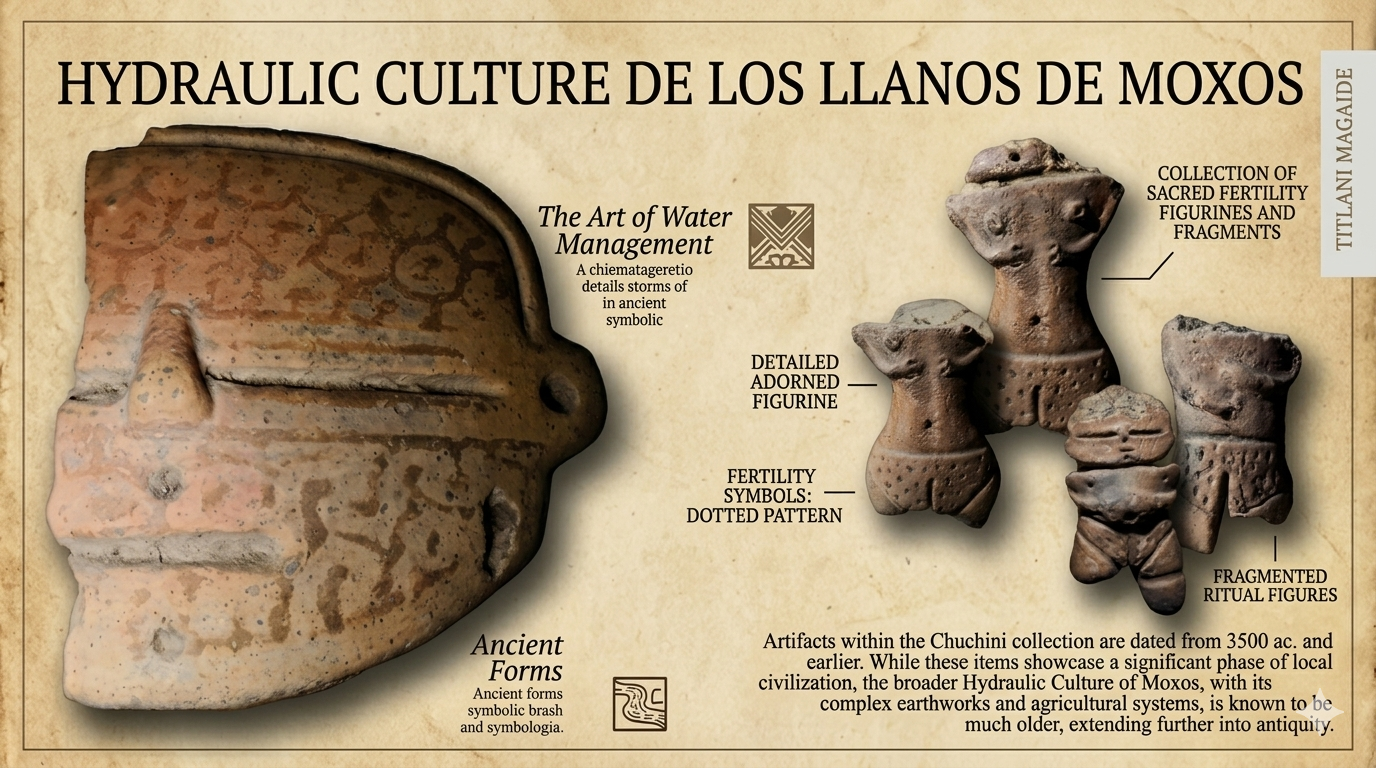
Chuchini is known for its great archaeological importance, since in the 1970s were carried out excavation works in small-scale in charge of the Argentine mission. In this artificial Hill is to the surface land archaeological sites that speak of the mysterious past of a culture not yet known; classified as pre-Columbian and 3,000 years b.c. (Kenneth Lee, 1995)., Dr. Clarck Erickson of the University of Pennsylvania and the (INAR) researchers Wilma Winkler, Marcos Michel (July 1990) put knowledge to the national authorities of the importance of these hills that have been witness to the pre-Columbian Mojena hydraulic culture. Result of the excavation and a collection since 1974 was able to get around 1,500 archaeological pieces that are today exhibited in a small archaeological museum on the site.
 English
 Español
 Deutsch
 Français
 Nederlands
 Dansk
Dansk Italiano
 日本語
日本語 한국어
한국어 简体中文
简体中文 Português do Brasil